Gold Price Today: Why Gold Keeps Climbing
Gold is doing something that normally shouldn’t be this easy.
Interest rates remain elevated. U.S. Treasury yields have moved above 5%. The U.S. dollar has strengthened at times.
Those conditions would normally create significant competition for an asset that pays no interest.
Yet the gold price today remains historically elevated.
Gold has experienced pullbacks from its highs, but the bigger question remains:
Why has gold remained so expensive despite high interest rates and rising bond yields?
The answer involves much more than inflation.
Central-bank buying, reserve diversification, geopolitical uncertainty, the U.S. dollar, real interest rates and investor demand are all influencing the market at the same time.
GOLD ↑
YIELDS ↑
HOW?!
Watch: Gold Price Today — Why Gold Keeps Climbing
Watch the InvestingLab video below for a visual explanation of the forces driving gold prices, including Treasury yields, central-bank buying, the U.S. dollar, investment demand and geopolitical risk.
Where is the Gold Price Today?
Gold has pulled back from its recent highs, showing that even a powerful long-term rally does not move in a straight line.
On October 2, 2026, Reuters reported spot gold trading around $4,140 per ounce, with prices down for the week as a stronger U.S. dollar and elevated Treasury yields created pressure.
That short-term weakness does not erase the bigger story.
Gold remains at historically elevated price levels despite financial conditions that would traditionally be considered challenging for the metal.
This distinction matters:
GOLD DOES NOT GO UP EVERY DAY
The more interesting question is why it has remained so strong over the broader cycle.
Why Is the Gold Price Rising?
There is no single explanation for the gold-price rally.
Instead, gold is being influenced by several competing forces:
| Supporting Gold | Pressuring Gold |
|---|---|
| Central-bank purchases | Higher Treasury yields |
| Reserve diversification | Higher real interest rates |
| Geopolitical uncertainty | Stronger U.S. dollar |
| Safe-haven demand | Investor profit-taking |
| Long-term investment demand | Competition from interest-bearing assets |
The current gold price reflects the balance of all these forces—not just one economic indicator.
1. Central Banks Are Buying Gold
One of the biggest structural changes in the gold market has been strong demand from central banks.
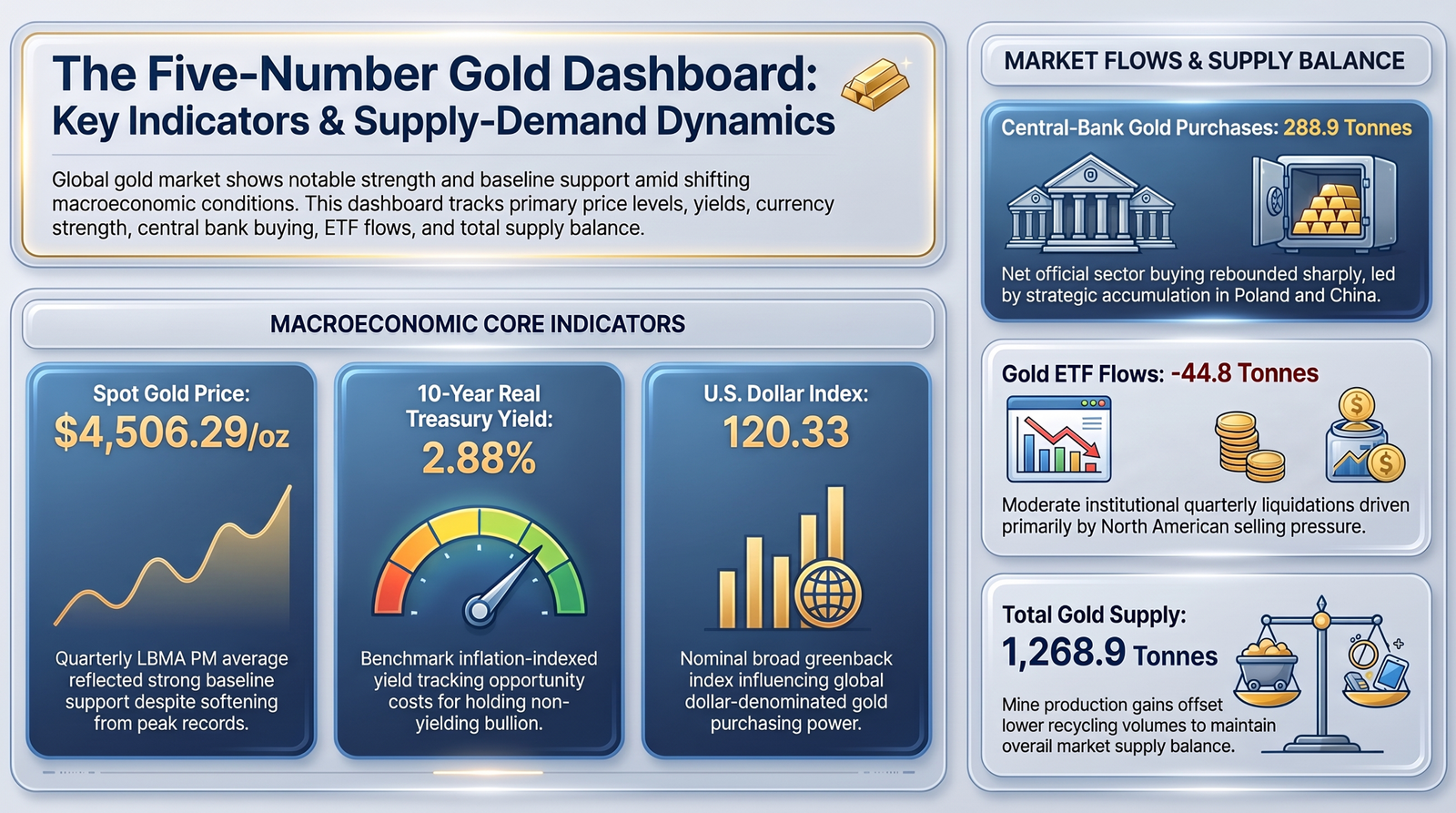
According to the World Gold Council, central banks purchased approximately 289 tonnes of gold on a net basis during the second quarter of 2026.
That represented a substantial increase compared with the same quarter a year earlier.
Central banks hold gold as part of their international reserves for several reasons.
- Reserve diversification
- Liquidity
- Long-term store-of-value characteristics
- Reduced exposure to a single currency
- Geopolitical risk management
Gold also differs from a government bond because the metal itself does not represent another country’s direct promise to repay a debt.
That characteristic can make it attractive to reserve managers concerned about geopolitical or currency risk.
Central-Bank Gold Buying Is Bigger Than One Quarter
The trend extends beyond a single quarter.
The World Gold Council reports that central banks averaged roughly 1,000 tonnes of gold purchases annually during the previous four years—approximately double the average pace seen over the preceding decade.
Its 2026 survey of central-bank reserve managers also found that a large majority expected official-sector gold holdings globally to continue increasing.
Survey expectations do not guarantee future purchases, but they help explain why central-bank demand has become such an important part of the gold-price story.
A central bank adding gold to reserves can represent a long-term allocation decision rather than a short-term trade based on today’s price.
2. Gold and Interest Rates: Why Higher Yields Normally Hurt
Gold has one major disadvantage compared with bonds:
Gold does not pay interest.
If a Treasury security offers an attractive yield, an investor can potentially earn interest simply by holding that bond to the appropriate maturity, subject to the terms and risks involved.
A bar of gold does not generate a coupon payment.
That creates an opportunity cost.
REAL YIELDS ↑
↓
INTEREST-BEARING ASSETS BECOME MORE COMPETITIVE
↓
POTENTIAL HEADWIND FOR GOLD
But this relationship is not mechanical.
Gold can sometimes remain strong even while interest rates and bond yields rise if other sources of demand are powerful enough.
That is exactly what makes the current environment unusual.
3. Real Interest Rates Matter More Than Nominal Rates Alone
Investors often watch real interest rates when evaluating gold.
A real interest rate attempts to account for inflation rather than looking only at the headline interest rate.
Conceptually:
NOMINAL INTEREST RATE − INFLATION ≈ REAL RATE
When inflation-adjusted yields become more attractive, gold faces greater competition from financial assets that generate income.
When real yields decline, the opportunity cost of holding non-yielding gold may become less significant.
Again, this relationship can weaken or temporarily break when other factors dominate.
4. The U.S. Dollar Can Move Gold Prices
Gold is commonly quoted internationally in U.S. dollars.
That makes the value of the dollar another important variable.
A stronger dollar can make dollar-priced gold more expensive for buyers whose home currency has weakened.
That can create a headwind for demand.
A weaker U.S. dollar can have the opposite effect.
But once again:
Dollar up does not automatically mean gold down.
Gold prices reflect many forces simultaneously.
5. Geopolitical Risk Can Increase Safe-Haven Demand
Gold has historically been viewed by many investors and institutions as a potential safe-haven asset during periods of uncertainty.
That can include concerns involving:
- Wars and geopolitical conflicts
- Financial-market instability
- Currency uncertainty
- Government debt concerns
- International sanctions or reserve risk
However, the phrase safe haven should not be interpreted as meaning that gold cannot lose value.
Gold prices can fall sharply and can remain volatile even during uncertain economic periods.
6. Reserve Diversification Is Becoming More Important
Another important theme behind the gold-price rally is reserve diversification.
Central banks hold reserves in different forms, which may include foreign currencies, government securities and gold.
Increasing gold allocations can reduce dependence on any single currency or foreign government security.
This does not mean the world’s central banks are abandoning the U.S. dollar.
Rather, some institutions appear to be increasing gold as one component of a diversified reserve portfolio.
7. Gold ETF Investors and Central Banks Can Move in Opposite Directions
One of the most interesting features of today’s gold market is that different groups of buyers are not necessarily behaving the same way.
The World Gold Council reported that gold-backed exchange-traded funds experienced approximately 45 tonnes of net outflows during Q2 2026.
At the same time, central banks were net buyers.
CENTRAL BANKS → BUYING
SOME GOLD ETFs → OUTFLOWS
Different parts of the gold market can move in opposite directions.
This is important because there is no single category of “gold investor.”
Central banks, ETF investors, jewelry buyers, physical bullion investors and institutional traders may all respond to different incentives.
8. Gold Supply Cannot Increase Overnight
Gold supply is another important part of the equation.
Higher prices can encourage more mine production and recycling, but mining supply cannot expand instantly.
Developing a major mine may involve:
- Exploration
- Environmental approvals
- Permitting
- Large capital investment
- Construction
- Years of development
That relatively slow supply response means a significant increase in demand can have an outsized effect on price.
Does Inflation Always Make Gold Go Up?
No.
This is one of the most common oversimplifications surrounding gold.
Gold is often discussed as an inflation hedge, but the relationship between consumer-price inflation and gold prices can vary dramatically across different periods.
Inflation can influence gold indirectly through:
- Central-bank interest-rate decisions
- Real yields
- Currency values
- Investor expectations
- Economic uncertainty
Therefore:
INFLATION ↑ ≠ GOLD MUST ↑
Why Hasn’t 5%+ Treasury Yield Crushed Gold?
This may be the most interesting question in the current market.
Higher bond yields create a genuine headwind because they offer investors income that gold cannot provide.
Yet structural demand has remained unusually strong.
The market can therefore be thought of as a tug-of-war:
| Gold Headwinds | Gold Support |
|---|---|
| High Treasury yields | Central-bank buying |
| Positive real yields | Reserve diversification |
| Strong U.S. dollar | Geopolitical uncertainty |
| ETF outflows at times | Safe-haven and physical demand |
The gold price reflects which side of that tug-of-war investors collectively believe is more important at any given moment.
5 Numbers to Watch for Gold Prices
Rather than trying to predict tomorrow’s gold price, investors can better understand the market by watching several major indicators.
1. Spot Gold Price
Shows the current market price and broader trend.
2. 10-Year Real Treasury Yield
Helps measure the opportunity cost of holding a non-yielding asset.
3. U.S. Dollar Index
A stronger or weaker dollar can influence global gold demand.
4. Central-Bank Purchases
Tracks one of the most important structural sources of demand.
5. Gold ETF Flows
Provides insight into financial-investor demand.
Bonus: Geopolitical Risk
Periods of instability can influence safe-haven demand.
Is a High Gold Price Good or Bad?
A high gold price does not have one universal meaning.
For existing gold holders, higher prices increase the market value of their holdings.
For new buyers, higher prices mean paying more for each ounce.
For jewelry consumers, higher raw-material prices can raise costs.
For miners, higher prices can potentially improve revenue economics—but mining costs, production levels and operational risks also matter.
This is why the gold price itself should not automatically be interpreted as a buy or sell signal.
Gold Is Different From Stocks and Bonds
Gold is fundamentally different from many traditional financial assets.
| Asset | Potential Economic Return |
|---|---|
| Stock | Business earnings, dividends and changes in valuation |
| Bond | Interest payments and repayment according to contract terms |
| Gold | Primarily changes in market price; physical gold itself does not generate earnings or interest |
That is why gold valuation depends heavily on supply, demand, opportunity cost and investor perceptions rather than corporate earnings or contractual interest payments.
Frequently Asked Questions About Gold Prices
Why is the gold price so high?
Gold’s historically elevated price reflects several factors, including strong central-bank purchases, reserve diversification, geopolitical uncertainty and investment demand. Higher Treasury yields and a stronger U.S. dollar can work in the opposite direction.
Why is gold going up when interest rates are high?
Higher interest rates normally create competition for gold because gold itself does not pay interest. However, strong central-bank buying, geopolitical uncertainty and reserve diversification can sometimes outweigh that headwind.
Does gold always rise when inflation increases?
No. Gold and inflation do not have a guaranteed one-to-one relationship. Inflation can affect gold indirectly through real interest rates, monetary policy, currency values and investor expectations.
Why are central banks buying gold?
Central banks may hold gold for reserve diversification, liquidity, long-term store-of-value characteristics and reduced dependence on any single currency or foreign government issuer.
Does a stronger dollar hurt gold?
A stronger U.S. dollar can create a headwind because gold is commonly priced in dollars, potentially making it more expensive for buyers using other currencies. However, the relationship is not perfect and other demand factors can dominate.
Why do Treasury yields matter for gold?
Gold does not generate interest income. When Treasury and real yields rise, interest-bearing assets may become more attractive relative to gold, increasing gold’s opportunity cost.
Is gold a safe investment?
Gold can experience substantial price volatility and can lose value. Although it is often described as a safe-haven asset, that term does not mean gold is risk-free or guaranteed to rise during market stress.
Will the gold price keep rising?
No one can know with certainty. Future gold prices will depend on factors including interest rates, real yields, the U.S. dollar, central-bank buying, investor demand, supply and geopolitical developments.
The Bottom Line
The story behind the gold price today is not simply that “inflation is high” or that investors are afraid.
Gold is currently caught between two powerful groups of forces.
On one side:
- High Treasury yields
- Positive real rates
- A stronger U.S. dollar at times
- Competition from interest-bearing assets
On the other:
- Central-bank buying
- Reserve diversification
- Geopolitical uncertainty
- Safe-haven demand
- Long-term physical and institutional demand
The fact that gold remains historically elevated despite strong bond yields suggests that structural demand has become an especially important part of today’s market.
GOLD ↑ + YIELDS ↑
The contradiction is the story.
Watch demand, real yields and the dollar—not just the headline gold price.
Understanding those forces is more useful than trying to predict where gold trades tomorrow.
Sources & Further Reading
- Reuters — Gold Remains Resilient Despite Surging U.S. Bond Yields
- Reuters — Gold Price, Dollar and Treasury Yield Update
- World Gold Council — Gold Demand Trends Q2 2026
- World Gold Council — Central-Bank Gold Demand
- World Gold Council — 2026 Central Bank Gold Reserves Survey
- World Gold Council — Gold Investment and ETF Demand
- Federal Reserve Bank of St. Louis — 10-Year Real Treasury Yield
- Federal Reserve Bank of St. Louis — Broad U.S. Dollar Index
Market-data note: Gold prices, bond yields, currencies and investment flows change continuously. Price figures in this article refer to the specific dates identified and should not be interpreted as current quotes after publication.
Editorial note: The phrase “why gold keeps climbing” describes the broader historic gold-price trend. Gold does not rise every day and can experience substantial corrections and volatility.
Disclaimer: InvestingLab provides educational and informational content only. Nothing in this article constitutes financial, investment, tax or legal advice or a recommendation to buy, sell or hold gold, precious metals, securities or any other investment. All investments involve risk.
Learn more about InvestingLab’s educational methodology at How InvestingLab Calculators Work →