Budgeting Tips for Beginners: How to Take Control of Your Money in 2026
Practical budgeting tips for beginners covering money management, the best ways to save money, clever ways to cut costs on groceries, and simple habits to save money every month — with a free budget template to get started today.
The best budgeting tips for beginners are not complicated — they are consistent. According to a 2025 survey by Debt.com, 69% of Americans live paycheck to paycheck despite 86% claiming to have a budget. The problem is not that people lack a budget — it is that most budgets are never properly built or maintained. These budgeting tips for beginners cut through the noise and give you a simple, practical system you can start today, even if you have never budgeted before.
This guide covers essential budgeting tips, the best money management tips for beginners, clever ways to save money on everyday expenses, how to save money on groceries, and the most effective ways to save money each month — whether you are starting from zero or rebuilding after financial setbacks.
Why Budgeting Tips for Beginners Matter More Than Ever in 2026
US credit card balances hit a record $1.23 trillion in late 2025 (New York Federal Reserve), and 37% of American adults still cannot cover a $400 emergency without borrowing money (Federal Reserve SHED survey). With food prices up 2.7% year-over-year and energy costs surging into 2026, following solid budgeting tips for beginners is not optional — it is the foundation of every other financial goal you have.
The good news: you do not need to be a financial expert to build a budget that works. The most effective budgeting tips are the ones that are simple enough to stick with month after month. Use our free Budget Planner Calculator to put these tips into action in minutes — no spreadsheet skills required.
Budgeting Tip #1: Know Your Real Take-Home Income
The very first of our budgeting tips for beginners sounds obvious — but most people get it wrong. Your budget must be built on your net income (after taxes and deductions), not your gross salary. Budgeting based on gross income is one of the most common reasons new budgets fail in the first month.
Add up every source of monthly take-home income: your primary salary, any side income, freelance work, benefits, or investment distributions. If your income varies month to month, calculate a conservative 3–6 month average to use as your baseline. This gives you a realistic floor to budget from rather than an optimistic ceiling.
The best way to save money starts with knowing exactly what you have available. Once you have a clear income figure, every other budgeting tip in this guide becomes easier to apply. Use our Budget Planner Calculator to enter your monthly income and immediately see how it maps across spending categories.
Budgeting Tip #2: Track Every Dollar Before You Cut Anything
One of the most important money management tips for beginners is to track your spending for at least 30 days before making any cuts. Most people significantly underestimate how much they spend in categories like dining out, subscriptions, and online shopping — often by 30–50%.
Go through your last 2–3 months of bank and credit card statements and categorise every transaction into groups:
- Fixed expenses — rent/mortgage, utilities, insurance, loan payments (these do not change month to month)
- Variable necessities — groceries, transportation, healthcare (these change but are non-negotiable)
- Discretionary spending — dining out, entertainment, subscriptions, shopping (these are where most budgeting tips focus)
- Savings & debt payments — emergency fund, retirement contributions, extra debt payments
This exercise almost always reveals several clever ways to save money you had not noticed — forgotten subscriptions, habitual takeout spending, or duplicate services. You cannot cut what you cannot see. The Budget Planner Calculator has pre-built categories for all of these to make this process quick and visual.
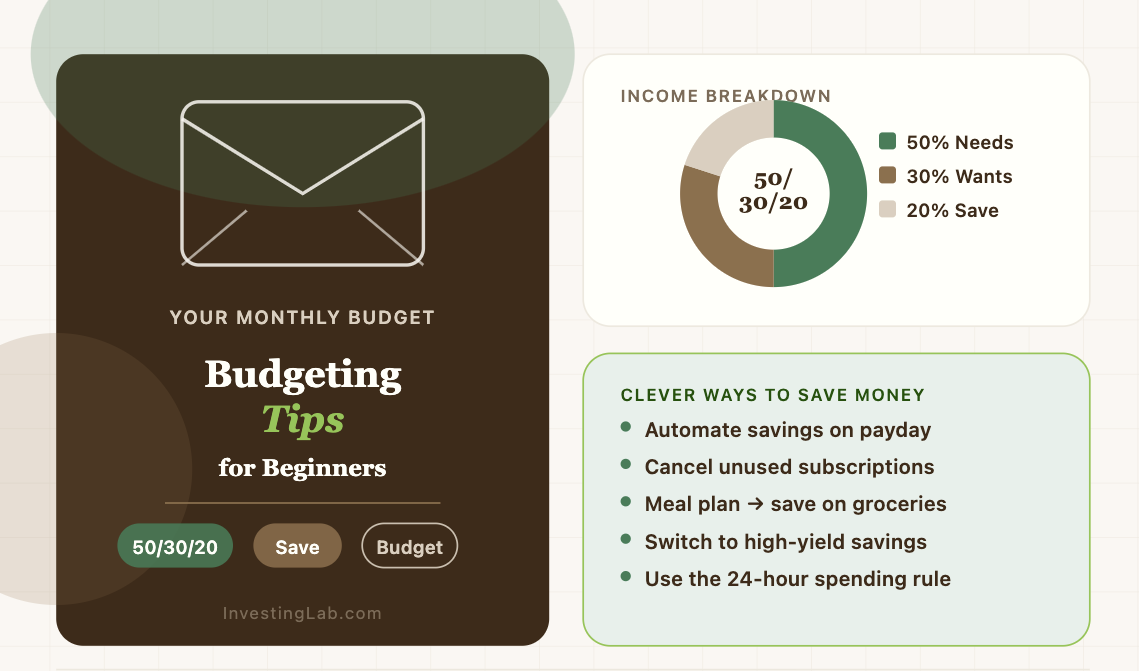
Budgeting Tip #3: Use the 50/30/20 Rule as Your Starting Framework
The most beginner-friendly of all budgeting tips is the 50/30/20 rule — one of the most widely recommended frameworks in personal finance. It divides your after-tax income into three buckets:
- 50% — Needs: Housing, utilities, groceries, transportation, insurance, minimum debt payments — the essentials you cannot skip.
- 30% — Wants: Dining out, entertainment, subscriptions, travel, hobbies — spending that improves your quality of life but is discretionary.
- 20% — Savings & debt: Emergency fund, retirement contributions, extra debt payments, investments — money working toward your future.
The 50/30/20 rule is not a rigid law — it is a diagnostic tool. If your “needs” are consuming 65% of your income, that tells you housing or debt costs are too high relative to your income. If you are saving less than 10%, that flags a priority shift. The value of this budgeting tip is not in perfect adherence — it is in making the imbalances visible. Our Budget Planner Calculator shows your actual percentage breakdown automatically once you enter your numbers.
Budgeting Tip #4: Pay Yourself First — Automate Your Savings
One of the most powerful budgeting tips for beginners is deceptively simple: move money to savings on the same day your pay hits your account — before you spend anything else. This is called paying yourself first, and it is the single most reliable way to build savings consistently.
When savings are automatic, you remove willpower from the equation entirely. You spend what is left after saving, not save what is left after spending. Even starting with just 5–10% of your take-home pay each month adds up dramatically over time. At $200 per month with a 5% annual return, you build over $30,000 in 10 years — purely from automation.
Set up an automatic transfer to a separate high-yield savings account (HYSA) on payday. Do not keep savings in your primary checking account where it blends into everyday spending. Separation is a core principle across the best money management tips for beginners — what you cannot easily access, you will not accidentally spend.
Budgeting Tip #5: Build Your Emergency Fund Before Anything Else
Among all the budgeting tips for beginners, this is the one that protects everything else you build. An emergency fund is a dedicated cash reserve — separate from your regular savings — held specifically for unexpected expenses: a car repair, medical bill, job loss, or appliance replacement.
The target is 3–6 months of essential living expenses (rent, groceries, utilities, minimum debt payments). If that feels overwhelming, start with a $1,000 starter emergency fund as your first milestone. According to the Federal Reserve, 37% of US adults cannot cover a $400 emergency without borrowing — a $1,000 buffer already puts you ahead of most households.
Without an emergency fund, every unexpected expense lands on a credit card — which is how people who do have budgets still end up in debt. The emergency fund is not optional: it is the foundation that makes every other budgeting tip sustainable long term.
Clever Ways to Save Money Every Month
Once you have the basics in place, these clever ways to save money consistently compound into significant monthly savings — without requiring dramatic lifestyle changes. These are among the most practical ways to save money each month for beginners.
Cancel and Audit Subscriptions Monthly
The average American household pays for 4–5 streaming or software subscriptions they rarely use. Set a recurring calendar reminder on the first of every month to review all active subscriptions. Cancel anything you have not used in the last 30 days. This single budgeting tip commonly frees up $40–$120 per month with zero lifestyle impact.
Switch to a High-Yield Savings Account
One of the simplest clever ways to save money is to move idle cash from a standard savings account (earning 0.01–0.5% APY) to a high-yield savings account (currently paying 4–5% APY). On a $5,000 emergency fund, that difference is roughly $200–$250 per year in extra interest — for zero additional effort.
Use the 24-Hour Rule for Discretionary Purchases
Before any non-essential purchase over $30, wait 24 hours. For purchases over $100, wait 48–72 hours. This pause eliminates a significant portion of impulse spending — one of the most effective clever ways to save money that costs nothing to implement. Most impulse purchases feel far less necessary after 24 hours.
Lower Your Bills — Without Cutting Services
Call your phone, internet, and insurance providers annually and ask for a loyalty discount or match a competitor’s rate. Most providers have unpublished retention offers. The average household can save $200–$500 per year through bill negotiation alone — one of the highest-return ways to save money each month for the time invested.
Meal Prep to Reduce Takeout and Food Waste
Preparing meals in batches once or twice a week is among the most powerful budgeting tips for beginners for cutting food costs. The average American family wastes 30–40% of their food budget through spoilage and food waste (USDA). Meal prepping reduces waste, eliminates weeknight takeout decisions, and brings significant savings without sacrificing nutrition.
How to Save Money on Groceries
Groceries are one of the largest and most flexible spending categories in most household budgets — which makes them one of the best places to apply budgeting tips. Here are the most effective ways to save money on groceries without eating worse.
Plan Your Meals Before You Shop
Meal planning is the single most effective way to save money on groceries. Write out 5–7 dinners for the week, list every ingredient you need, check your pantry first, and only buy what is on the list. This eliminates impulse purchases and ensures everything you buy gets used. Studies consistently show meal planners spend 15–25% less at the grocery store than those who shop without a plan.
Shop Store Brands
Store-brand (generic) products are typically 20–30% cheaper than name-brand equivalents and are often manufactured by the same suppliers. For pantry staples — pasta, canned goods, cooking oils, spices, cleaning products — store brands almost always deliver the same quality at a significantly lower price. This is one of the simplest clever ways to save money with no noticeable downside for most household purchases.
Shop Markdowns and Reduced Sections
Most supermarkets mark down meat, bakery, and produce approaching its sell-by date — typically early morning or late evening. These items are perfectly safe to buy and freeze. Shopping the markdown section is a reliable way to save money on groceries by 30–50% on proteins and produce that would otherwise cost full price.
Use Cashback and Loyalty Apps
Apps like Ibotta, Fetch Rewards, and your supermarket’s own loyalty program offer cash back on everyday grocery items. Combining store loyalty points with a cashback credit card (paid in full each month) is one of the most clever ways to save money on spending you are going to do anyway. Many households earn $15–$40 per month in cashback on groceries alone.
Buy Protein in Bulk and Freeze
Meat and proteins are the most expensive grocery category for most households. Buying larger packs — whole chickens, family packs of ground beef, bulk fish — and portioning them into freezer bags at home costs significantly less per unit than individual servings. This is one of the highest-impact ways to save money each month on groceries for families and individuals alike.
💡 Grocery budgeting tip: The USDA estimates the average American family wastes 30–40% of the food they buy. Eliminating food waste alone is one of the most powerful ways to save money on groceries without changing what you eat. Use a weekly meal plan and shop with a list — every time.
Best Budgeting Methods for Beginners: Find the One That Sticks
These budgeting tips for beginners work across multiple systems. Here are the four most beginner-friendly money management tips frameworks — pick the one that fits your personality:
1. The 50/30/20 Budget
Best for beginners who want a simple starting point. Divide your after-tax income into 50% needs, 30% wants, and 20% savings/debt. No detailed category tracking required — just monitor three buckets. This is the most forgiving of all budgeting tips systems for people who dislike rigid rules.
2. Zero-Based Budgeting
Best for detail-oriented people who want complete control. Every dollar of income is assigned a specific purpose — bills, groceries, savings, entertainment — until income minus allocations equals zero. Nothing is unaccounted for. This is one of the most powerful money management tips for beginners for people who feel like money “disappears” each month without explanation.
3. The Pay-Yourself-First Budget
Best for people who struggle to save. Automate savings and investments first (10–20% of income), then spend the remainder however you choose. This is the simplest system and one of the most effective best way to save money frameworks because it requires the fewest ongoing decisions.
4. The Envelope Method
Best for people who overspend in specific categories. Allocate physical cash (or virtual “envelopes” using a budgeting app) for each discretionary category — groceries, dining out, entertainment — and stop spending in that category when the envelope is empty. The physical constraint is what makes this one of the most effective budgeting tips for beginners who struggle with card spending.
Ways to Save Money Each Month: A Quick-Reference Checklist
Here is a consolidated checklist of the most effective ways to save money each month drawn from the budgeting tips for beginners in this guide:
- Automate a savings transfer on payday — even $50–$100 per month to start
- Audit and cancel unused subscriptions — target $40–$80 in monthly savings
- Meal plan weekly and shop with a list to save money on groceries
- Switch idle cash to a high-yield savings account (4–5% APY in 2026)
- Apply the 24-hour rule to all non-essential purchases over $30
- Call your phone, internet, and insurance providers for loyalty discounts annually
- Buy store-brand groceries for pantry staples — save 20–30% vs name brands
- Pack lunch at least 3 days per week — saves the average worker $150–$250 per month
- Use a cashback app or card for grocery and fuel purchases you make anyway
- Review your budget every month — a budget you never revisit cannot help you
Use our free Budget Planner Calculator to track all of these categories in one place and see your total monthly surplus or deficit update in real time as you adjust numbers.
Sources & Reference Links
Statistics on household financial health and emergency fund coverage referenced in this article come from the Federal Reserve’s Survey of Household Economics and Decisionmaking (SHED), published annually.
Credit card balance data ($1.23 trillion record, late 2025) is sourced from the Federal Reserve Bank of New York Household Debt and Credit Report.
Food waste statistics (30–40% of US food supply wasted) reference published guidance from the US Department of Agriculture (USDA) Food Waste FAQs.
These external links are provided for general reference. InvestingLab.com is not affiliated with these organisations.
FAQ
Common questions about budgeting tips for beginners, money management, and ways to save money.
What are the best budgeting tips for beginners?
What is the best way to save money for beginners?
What are clever ways to save money without feeling deprived?
How can I save money on groceries every week?
What are the best money management tips for beginners?
How much should a beginner save each month?
What is the 50/30/20 rule and does it work for beginners?
Download Your Free Budget Planner Template
The fastest way to put these budgeting tips for beginners into practice is to start with a ready-made tool. Subscribe and download our FREE Budget Planner Template — a clean, pre-built spreadsheet designed specifically for beginners.
- Pre-built income and expense categories — just plug in your numbers
- Automatic surplus/deficit calculation so you see your position instantly
- 50/30/20 allocation tracker built in for quick diagnostics
- Monthly layout with annual summary — track progress over the full year
- No complicated formulas or financial knowledge required
👉 Download Free Budget Planner Template →
Already ready to run your numbers? Use our free Budget Planner Calculator — enter your income and expenses directly in your browser and see your full monthly budget breakdown instantly. No download or sign-up needed.
By subscribing, you agree to receive email updates. Unsubscribe anytime. See our Privacy Policy.
Disclaimer
This article is for general educational and informational purposes only. It does not provide financial, tax, or legal advice. Budgeting tips and savings estimates are illustrative and based on general guidelines — individual results will vary based on income, expenses, location, and personal financial circumstances. For assumptions and limitations, see How Calculators Work and Disclaimer.