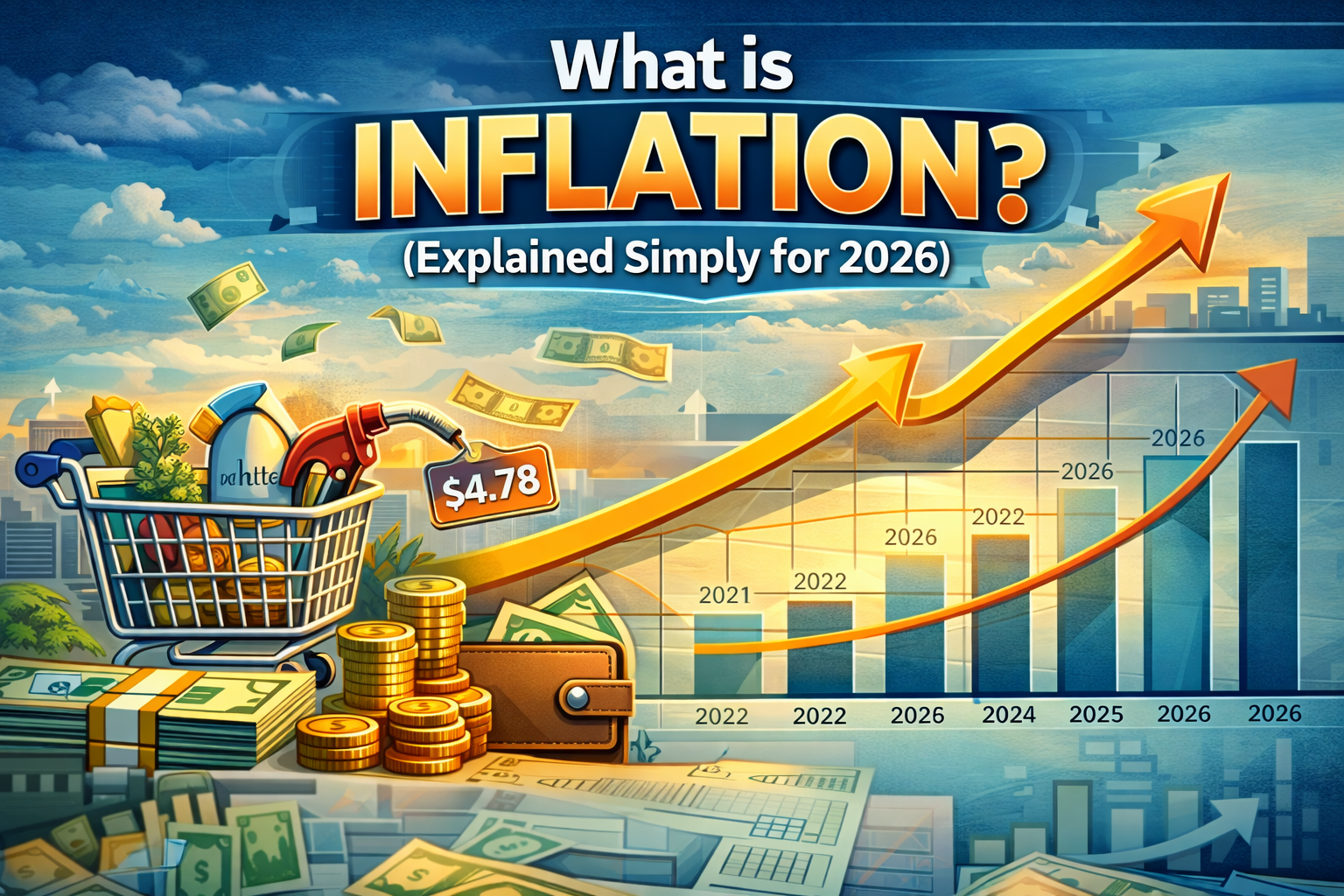
What is Inflation? (Explained Simply for 2026)
Educational breakdown of what is inflation: the current inflation rate today, what is causing inflation, stagflation, inflation relief checks, and how to protect your finances.
Searches for what is inflation usually want a simple answer — but what is inflation does not have a single definition that captures everything it affects. Inflation touches your grocery bill, rent, retirement savings, mortgage rate, and take-home pay all at once. Understanding what is inflation and what is causing inflation right now is the first step to protecting your finances from it.
This article explains what is inflation in plain terms, covers the inflation rate today, breaks down what is causing inflation in 2026, addresses inflation relief checks and stimulus payments, explains stagflation, and gives you practical steps to protect your household finances from rising prices.
What is Inflation?
What is inflation? Inflation is the rate at which the general level of prices for goods and services rises over time, reducing the purchasing power of money. In plain terms: the same dollar buys less than it used to. When people ask what is inflation and why it matters, the simplest answer is this — a dollar today does not go as far as a dollar last year.
If the inflation rate is running at 3%, something that cost $1.00 last year now costs $1.03. That sounds small, but compounded over 10 years at 3%, prices rise by about 34%. Over 20 years, they nearly double. Understanding what is inflation and its compounding effect matters enormously for long-term planning — especially retirement. Use our Retirement Planner Calculator to model exactly how inflation affects your projected nest egg over time.
Inflation is measured in the US by the Consumer Price Index (CPI), published monthly by the Bureau of Labor Statistics (BLS). The CPI tracks the cost of a “basket” of everyday goods and services — groceries, housing, gasoline, healthcare, clothing, and more — and compares it to the same basket in a prior period. A higher CPI reading means prices have risen; a lower reading means they have fallen. This is the primary tool used to answer what is inflation for any given month.
Want to see what is inflation doing to your monthly budget? Use our free Budget Planner Calculator to track income and expenses across every spending category and find exactly where rising prices are hitting you hardest.
What is the Inflation Rate Today? (2026 Update)
The current US inflation rate is 3.3% for the 12 months ending March 2026, according to the Consumer Price Index summary released by the Bureau of Labor Statistics on April 10, 2026. This is the highest reading since May 2024 and a sharp jump from 2.4% recorded in both January and February 2026. For anyone asking what is the inflation rate today or what is the rate of inflation right now — 3.3% is the official current figure.
| Period | Annual Inflation Rate (CPI-U) |
|---|---|
| December 2025 | 2.7% |
| January 2026 | 2.4% |
| February 2026 | 2.4% |
| March 2026 (latest) | 3.3% |
Source: U.S. Bureau of Labor Statistics, CPI-U (not seasonally adjusted). Next update: May 12, 2026.
The March 2026 spike was driven almost entirely by energy prices, which rose 10.9% in a single month — led by a 21.2% jump in gasoline prices linked to Middle East tensions. Core inflation (which strips out food and energy) was more moderate at 2.6% annually, suggesting the structural answer to what is inflation doing beneath the surface is closer to the Fed’s 2% target.
What is the rate of inflation right now compared to recent history? The current 3.3% is well below the 40-year peak of 9.1% reached in June 2022 — but it remains above the Federal Reserve’s long-term 2% target, which is why interest rates have stayed elevated heading into 2026.
What is Causing Inflation?
What is causing inflation is rarely one single thing. It is typically the result of several economic forces acting simultaneously. Here are the three most common drivers economists use to explain what is inflation at any given time.
1. Demand-Pull Inflation
When consumers have more money to spend — due to wage growth, government stimulus, or easy credit — demand for goods and services rises faster than supply can keep up. Businesses respond by raising prices. This is sometimes called “too much money chasing too few goods.” The post-COVID surge in consumer spending from 2021 to 2022 was a textbook example of demand-pull being what is causing inflation at scale.
2. Cost-Push Inflation
When the cost of producing goods rises — due to higher energy prices, raw material shortages, or supply chain disruptions — businesses pass those costs on to consumers through higher prices. The 2022–2023 surge was heavily cost-push. The March 2026 spike is a fresh example: surging gasoline prices are precisely what is causing inflation to jump sharply, rippling through transportation and food supply chains.
3. Built-In (Wage-Price) Inflation
When workers expect prices to keep rising, they demand higher wages. Higher wages raise business costs, which leads to higher prices, which leads to more wage demands. This self-reinforcing cycle — the wage-price spiral — is one reason central banks work hard to keep inflation expectations anchored. Once it starts, it is very difficult to break without raising interest rates significantly.
What is causing inflation right now in 2026? The dominant driver is energy — specifically gasoline, which jumped over 21% in March 2026 due to Middle East tensions. Beyond energy, shelter costs continue running at 3% annually and food prices remain at 2.7% year-over-year, both squeezing household budgets.
Headline Inflation vs Core Inflation: What is the Difference?
You will often see two figures when people discuss what is inflation today — headline and core. Understanding the difference helps you read financial news accurately and understand what the Federal Reserve is actually reacting to.
- Headline inflation includes everything in the CPI basket — food, energy, housing, healthcare, clothing, and more. It reflects what consumers actually pay. The current headline rate is 3.3%.
- Core inflation strips out food and energy prices, which tend to be volatile and driven by temporary factors. Core inflation is currently 2.6% — a better gauge of the underlying structural answer to what is inflation doing long term.
The Federal Reserve focuses primarily on a related measure called the PCE (Personal Consumption Expenditures) price index when setting interest rates, though the CPI is the most widely cited figure in the news. The gap between headline and core right now — 3.3% vs 2.6% — tells you the current spike is largely energy-driven and may moderate if gasoline prices fall.
What is Stagflation?
Stagflation is a particularly damaging economic condition that combines high inflation, slow economic growth, and high unemployment simultaneously. It sits at the extreme end of what is inflation risk — and is notoriously difficult for policymakers to address because the standard tools work in opposite directions.
To fight inflation, central banks raise interest rates — which slows growth and increases unemployment. But if the economy is already stagnating and unemployment is already rising, raising rates makes conditions worse. That is the stagflation trap, and it is why the 1970s oil crisis — the most severe US stagflation episode — took years of painful policy to resolve.
As of April 2026, the US economy is not in stagflation — GDP growth remains positive and unemployment is relatively low. However, rising energy prices and slowing consumer spending have led some economists to flag stagflation risk if what is inflation doing now continues to worsen while growth decelerates through the rest of 2026.
Inflation Relief: Are There Inflation Relief Checks or Stimulus Payments?
Many Americans searching for inflation relief want to know whether new government payments are coming to offset what is inflation doing to their household budgets. Here is the current, accurate picture — verified against official sources.
Federal Inflation Relief Stimulus Checks (2026)
No new federal inflation relief stimulus checks have been approved as of April 2026. The last federal economic impact payments went out in 2021. A final round of automatic payments — up to $1,400 per person for those who had not claimed the Recovery Rebate Credit on their 2021 tax returns — was issued between December 2024 and January 2025. The deadline to claim that credit was April 15, 2025, and has now passed with no extensions.
President Trump proposed a “$2,000 tariff dividend” in late 2025, funded by tariff revenue, but this has not been passed by Congress and no payment date has been announced. Economists have broadly cautioned that such inflation relief stimulus checks could actually worsen what is inflation by injecting additional consumer spending into an already elevated price environment.
State-Level Inflation Relief Checks
Some states have issued their own inflation relief payments. The most notable recent example is New York’s inflation refund checks, mailed in late 2025 under the 2025–2026 New York State budget. These one-time payments provided inflation relief to eligible residents who had paid increased sales taxes due to rising prices. The program has now concluded for that cycle. For state-specific programs, check your state’s department of taxation and finance website directly.
⚠️ Watch out for scams. Viral posts claiming “$2,000 IRS inflation payments” or “approved direct deposits” are overwhelmingly misinformation or outright scam attempts. The IRS does not announce payments through social media. Always verify at irs.gov directly before clicking any links or sharing personal information.
How What is Inflation Doing to Your Personal Finances
What is inflation doing to ordinary households right now? The answer varies by spending category — here is where the impact is felt most directly.
Your Grocery and Energy Bills
Food prices are up 2.7% year-over-year and gasoline is up over 18% as of March 2026. These are the most visible reminders of what is inflation in everyday life — felt every time you fill up your tank or check out at the supermarket. Our Budget Planner Calculator lets you track exactly where what is inflation hitting your spending hardest.
Your Rent and Housing Costs
Shelter costs — rent, homeowners’ equivalent rent, and lodging — make up roughly one-third of the entire CPI basket. With shelter inflation running at 3% year-over-year, housing is one of the most persistent parts of what is inflation right now. For renters especially, annual increases above wage growth represent a direct and compounding erosion of real purchasing power.
Your Savings and Cash
Cash sitting in a low-yield account loses real value during inflationary periods. If your savings account earns 0.5% and what is inflation running at is 3.3%, you are losing 2.8% of purchasing power annually — silently, without seeing a single dollar leave your account. High-yield savings accounts (currently paying 4–5% APY) at least partially offset what is inflation doing to your cash savings.
Your Retirement Nest Egg
What is inflation doing to retirement savings is arguably its most damaging long-term effect. A portfolio generating 6% nominal returns in a 3% inflation environment has a real return of only 3%. And $1,000,000 saved today is worth only about $540,000 in purchasing power 25 years from now at 2.5% annual inflation. Use our Retirement Planner Calculator to model this with an inflation adjustment included.
Your Debt
Here is one area where what is inflation can actually work in your favour: fixed-rate debt becomes cheaper in real terms during inflation. If you have a mortgage at a fixed 3.5% rate and what is inflation running at is 3.3%, the real cost of your debt is barely 0.2%. Your wages rise in nominal terms while your payment stays the same — making fixed-rate debt one of the rare beneficiaries of rising prices.
How to Protect Your Finances From What is Inflation Doing Right Now
You cannot control what is inflation, but you can structure your finances to be more resilient against it. Here are the most practical steps available to US households right now.
- Move idle cash to a high-yield savings account (HYSA). The best HYSAs currently pay 4–5% APY — at least partially offsetting what is inflation right now at 3.3%. Leaving cash in a 0.01% checking account is a guaranteed real loss every month.
- Invest for the long term. The S&P 500’s long-run real return is approximately 7% annually — well above what is inflation historically. Use our Asset Calculator to model how investments grow in real, inflation-adjusted terms.
- Consider I-Bonds or TIPS. Series I savings bonds (US Treasury) pay a rate that adjusts directly with what is inflation. TIPS similarly adjust their principal with the CPI — both are strong fixed-income options during elevated inflation periods.
- Review your budget every 3–6 months. A budget that worked last year may already be showing a deficit this year because of what is inflation doing to prices. Our Budget Planner Calculator makes this fast and free.
- Lock in fixed costs where possible. Fixed-rate mortgages, long-term service contracts, and annual memberships protect you from what is inflation doing to those specific spending categories.
- Negotiate your salary. A pay raise below what is inflation running at is a real pay cut. Use our Salary Calculator to understand your true take-home pay before your next salary conversation.
is All Inflation Bad? The Fed’s 2% Target Explained
Not all of what is inflation is harmful. The Federal Reserve targets a 2% annual inflation rate as the sweet spot for a healthy economy. A small, predictable amount of what is inflation encourages spending and investment rather than hoarding cash, gives central banks room to cut rates during recessions, reduces the real burden of fixed-rate debts over time, and signals that the economy is growing with healthy demand.
The problem arises when what is inflation runs significantly above 2% for extended periods — as it did from 2021 to 2023 — eroding real wages and forcing the Fed to raise rates aggressively. Equally, deflation (falling prices) can be even more damaging: it discourages spending, increases real debt burdens, and can spiral into recession. The 2% target keeps the economy safely between both extremes.
Want to understand your full financial picture in the context of what is inflation doing right now? Use our Net Worth Calculator to track assets and liabilities — including inflation-sensitive property and cash holdings — in one clear snapshot.
Sources & Reference Links
Inflation data in this article comes from the U.S. Bureau of Labor Statistics Consumer Price Index (CPI-U), released April 10, 2026. This is the primary official source for what is inflation data in the United States.
Information on inflation relief stimulus checks was verified against official sources including IRS.gov and the New York State Department of Taxation and Finance.
For additional context on what is inflation doing to long-term savings and retirement planning, see the Federal Reserve’s official guidance on inflation.
These external links are provided for general reference. InvestingLab.com is not affiliated with these organisations.
FAQ
Common questions about what is inflation, the current inflation rate today, and inflation relief.
What is inflation in simple terms?
What is the inflation rate today?
Are inflation relief checks or inflation relief stimulus checks coming in 2026?
What is stagflation?
What is inflation doing to my retirement savings?
What is core inflation and why does it matter?
Get a Free Budget Planner Template
Want a simple, practical budgeting spreadsheet to manage what is inflation doing to your monthly expenses? Subscribe and we’ll send you our FREE Budget Planner Template.
- Clean monthly layout with built-in formulas
- Designed for quick planning and scenario testing
- No complicated setup — just plug in your numbers
By subscribing, you agree to receive email updates. Unsubscribe anytime. See our Privacy Policy.
Disclaimer
This article is for general educational and informational purposes only. It does not provide financial, tax, or legal advice. Inflation data reflects published government figures and may change after publication. Always verify current rates at bls.gov. For assumptions and limitations, see How Calculators Work and Disclaimer.