
What are Non-Bank Financial Institutions? A Plain-English Guide
A comprehensive reference guide to non-bank financial institutions (NBFIs) — what they are, how they differ from banks, the major types, their role in the financial system, and how they are regulated in the United States. Suitable for students, researchers, and anyone seeking an accessible explanation of non-bank financial systems.
Non-bank financial institutions (NBFIs) are financial intermediaries that facilitate a wide range of financial services — including investment, risk pooling, credit provision, and market brokering — without holding a full commercial banking licence. They form a critical and often underappreciated component of the modern financial system, channelling capital between savers and borrowers through mechanisms distinct from traditional deposit-taking banks.
The term “non-bank financial institution” covers an enormous range of entities: insurance companies, pension funds, investment funds, hedge funds, mortgage companies, payday lenders, pawnbrokers, leasing companies, and microfinance institutions — among others. What unites them is the absence of a full banking charter and the associated regulatory requirements that come with deposit-taking. Understanding how NBFIs work, why they exist, and how they are regulated is fundamental to understanding how modern financial systems function.
Definition: What is a Non-Bank Financial Institution?
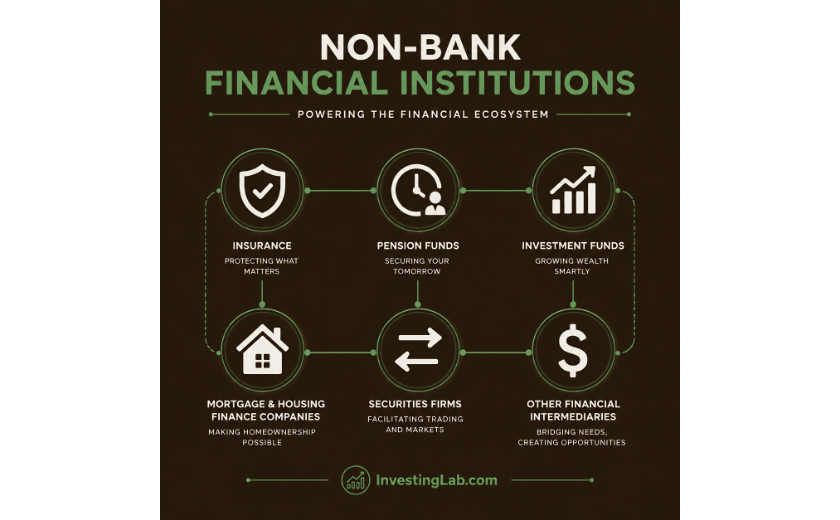 A non-bank financial institution (NBFI) is any financial intermediary that does not hold a full commercial banking licence but provides financial services to individuals, businesses, or governments. The defining characteristic is the absence of deposit-taking authority — NBFIs cannot accept demand deposits from the general public the way commercial banks can, and consequently they are not subject to the same primary banking regulations, including reserve requirements and deposit insurance obligations.
The Financial Stability Board (FSB) and the International Monetary Fund (IMF) refer to the broader non-bank financial sector as non-bank financial intermediation (NBFI) — sometimes also called the “shadow banking system” in academic and policy literature, though this term is increasingly disfavoured as it implies opacity that does not always apply to regulated NBFIs such as insurance companies or pension funds. The World Bank defines non-bank financial institutions as entities that “facilitate financial services such as investment, risk pooling, and market brokering” and that “generally do not have full banking licences.”
Banks vs Non-Bank Financial Institutions: Key Differences
The distinction between banks and non-bank financial institutions is fundamental to understanding financial regulation and systemic risk. The table below summarises the core differences:
| Feature | Commercial Banks | Non-Bank Financial Institutions |
|---|---|---|
| Banking licence | Full commercial banking charter required | Generally do not hold full banking licences |
| Deposit-taking | Can accept demand deposits from the public | Cannot accept demand deposits |
| Deposit insurance | FDIC-insured up to $250,000 per depositor (US) | Typically not FDIC-insured |
| Reserve requirements | Subject to reserve requirements (Fed) | Generally not subject to reserve requirements |
| Primary regulator (US) | Federal Reserve, OCC, FDIC, state banking depts | Varies: SEC, CFTC, state insurance depts, CFPB |
| Core financial services | Lending, deposit-taking, payments | Investment, risk pooling, market brokering, credit |
| Access to central bank liquidity | Direct access to Federal Reserve lending facilities | Generally no direct central bank access |
| Examples | JPMorgan Chase, Bank of America, Wells Fargo | BlackRock, Vanguard, Fidelity, MetLife, Rocket Mortgage |
Types of Non-Bank Financial Institutions
Non-bank financial institutions encompass a diverse range of entity types, each serving distinct functions within the financial system. The following categories represent the principal types of NBFIs recognised in academic literature and regulatory frameworks worldwide.
1. Insurance Companies
Insurance companies are among the largest and most economically significant NBFIs. They collect premium payments from policyholders and pool these funds to pay claims — a process known as risk pooling. Beyond claim payment, insurance companies invest the premium float in fixed-income securities, equities, and real assets, making them major institutional investors. In the United States, insurance companies are regulated at the state level through state insurance departments, not by federal banking regulators.
Types include: life insurance companies, health insurance companies, property and casualty insurers, mortgage insurance companies, and reinsurance companies. Major US examples include MetLife, Prudential Financial, Berkshire Hathaway, and State Farm.
2. Pension Funds
Pension funds manage retirement savings on behalf of employees and retirees, investing contributions into diversified portfolios of stocks, bonds, real estate, and alternative assets. They represent one of the largest pools of institutional capital globally. The two primary structures are defined benefit (DB) plans, which promise a specific retirement income, and defined contribution (DC) plans such as the 401(k), where the final benefit depends on investment performance.
In the United States, pension funds are regulated by the Department of Labor under the Employee Retirement Income Security Act (ERISA). Public pension funds — covering state and federal government employees — operate under separate legislative frameworks. Major examples include CalPERS, the Federal Thrift Savings Plan, and TIAA.
3. Investment Funds and Asset Managers
Investment funds pool capital from multiple investors and deploy it across diversified portfolios of financial assets. They facilitate market brokering — connecting capital supply with investment opportunities — and provide retail investors access to professional portfolio management and diversification.
- Mutual funds: open-end funds priced daily at net asset value (NAV); regulated under the Investment Company Act of 1940 in the US; examples include Vanguard and Fidelity index funds
- Exchange-traded funds (ETFs): similar to mutual funds but traded continuously on exchanges; have grown dramatically to represent over $10 trillion in assets in the US market
- Hedge funds: private investment pools using leverage, derivatives, and alternative strategies; typically restricted to accredited investors; lightly regulated relative to public funds
- Private equity funds: invest in private companies through buyouts, venture capital, and growth equity; capital is locked up for multi-year periods
- Real estate investment trusts (REITs): pool capital for investment in income-producing real estate; required to distribute at least 90% of taxable income to shareholders
4. Finance and Loan Companies
Finance companies provide loans and credit facilities to individuals and businesses but fund themselves through capital markets rather than deposits. They extend credit for consumer purchases, business equipment, commercial real estate, and working capital. Because they do not accept deposits, they are not subject to banking regulation — though they are subject to consumer lending laws including the Truth in Lending Act (TILA) and oversight by the Consumer Financial Protection Bureau (CFPB).
Examples include: auto finance companies (Ford Motor Credit, Toyota Financial Services), consumer finance companies (Synchrony Financial, Ally Financial), and commercial finance companies (GE Capital, CIT Group).
5. Mortgage Companies and Mortgage REITs
Mortgage companies originate and service home loans without holding banking licences. They fund mortgage origination through warehouse lines of credit and then sell loans to the secondary market — primarily to Fannie Mae, Freddie Mac, and Ginnie Mae — retaining servicing rights. Mortgage REITs invest in mortgage-backed securities and whole loans, funded through repo agreements and equity issuance.
The largest US mortgage companies include Rocket Mortgage (formerly Quicken Loans), United Wholesale Mortgage, and loanDepot. The 2008 financial crisis significantly exposed the systemic risks of unregulated mortgage origination and securitisation within the non-bank sector.
6. Microfinance Institutions (MFIs)
Microfinance institutions provide small loans, savings products, and financial services to individuals and small businesses who lack access to traditional banking — particularly in developing economies. They operate on the principle that access to credit enables economic participation by the unbanked population. Some MFIs operate as non-profits; others are for-profit licensed financial entities. Globally significant examples include Grameen Bank (Bangladesh) and BancoSol (Bolivia).
7. Securities Firms and Broker-Dealers
Securities firms and broker-dealers facilitate the trading of financial instruments in primary and secondary markets. They provide market brokering services — executing transactions on behalf of clients — and may also act as market makers, providing liquidity by trading from their own inventory. In the United States, broker-dealers are regulated by the Securities and Exchange Commission (SEC) and the Financial Industry Regulatory Authority (FINRA).
8. Payday Lenders and Pawnbrokers
At the consumer end of the non-bank spectrum, payday lenders offer short-term, high-cost credit typically secured by the borrower’s next paycheck. Pawnbrokers extend collateralised short-term loans secured against physical assets. Both serve credit-constrained consumers who cannot access traditional bank credit. They are regulated at the state level in the US, with federal oversight by the CFPB for larger operators.
9. Leasing Companies
Leasing companies provide access to assets — equipment, vehicles, real estate — through lease agreements rather than outright purchase. Operating leases allow businesses to use assets without ownership; finance leases transfer most ownership risks to the lessee. Equipment leasing is a major form of business finance for sectors including aviation, manufacturing, healthcare, and technology.
The Role of Non-Bank Financial Institutions in the Financial System
Non-bank financial institutions perform three core economic functions within the broader financial system, as identified in the World Bank’s landmark publication on NBFI development and regulation (Carmichael and Pomerleano, 2002):
1. Investment Intermediation
NBFIs channel savings from households and institutional investors into productive investment — equity markets, corporate bonds, real estate, infrastructure, and private businesses. Asset managers, pension funds, and insurance companies collectively represent trillions of dollars of intermediated capital. Without NBFIs, much of this capital would remain in low-yield bank deposits rather than being allocated to its highest-value uses in the economy.
2. Risk Pooling and Transfer
Insurance companies and pension funds perform the fundamental economic function of risk pooling — aggregating individual risks into statistically predictable collective outcomes and spreading financial risk across large numbers of participants. This function reduces the cost of individual risk-bearing and enables economic activities — home ownership, business formation, medical care — that individuals could not undertake if they bore the full risk alone.
3. Market Brokering and Liquidity Provision
Broker-dealers and market makers provide the liquidity that makes secondary market trading possible — ensuring that investors can buy and sell financial assets at fair prices without significant price impact. Without market brokering intermediaries, financial markets would be illiquid and capital would be locked into long-term commitments, reducing the efficiency of capital allocation across the economy.
💡 Scale context: The non-bank financial sector globally exceeded $218 trillion in assets under management as of 2022, according to the Financial Stability Board’s annual Global Monitoring Report — representing approximately 49% of total global financial assets. In the United States, NBFIs account for the majority of total financial system assets when including pension funds, mutual funds, insurance companies, and mortgage companies.
Regulation of Non-Bank Financial Institutions
Because non-bank financial institutions do not hold banking licences, they fall outside the primary banking regulatory framework — the Federal Reserve, Office of the Comptroller of the Currency (OCC), and FDIC in the US. Instead, different categories of NBFIs are regulated by a fragmented set of authorities depending on their function:
- Investment funds and broker-dealers: regulated by the Securities and Exchange Commission (SEC) and the Financial Industry Regulatory Authority (FINRA) under the Investment Company Act of 1940 and the Securities Exchange Act of 1934
- Insurance companies: regulated at the state level by individual state insurance departments; no federal insurance regulator exists in the US, though the Federal Insurance Office (FIO) within the Treasury monitors systemic risk
- Pension funds: regulated by the Department of Labor under ERISA for private-sector plans; state governments regulate public-sector pension funds
- Consumer lending and finance companies: regulated by the Consumer Financial Protection Bureau (CFPB) for compliance with consumer protection laws including TILA, ECOA, and FCRA
- Derivatives dealers: regulated by the Commodity Futures Trading Commission (CFTC) for swaps and futures under the Dodd-Frank Act
- Systemically important NBFIs: certain large non-bank financial companies can be designated as Systemically Important Financial Institutions (SIFIs) by the Financial Stability Oversight Council (FSOC), subjecting them to enhanced Federal Reserve oversight
The Regulatory Gap and Systemic Risk
The regulatory gap between banks and NBFIs has been a source of financial instability. The 2008 Global Financial Crisis demonstrated how non-bank mortgage originators, money market funds, repo markets, and structured investment vehicles — all outside traditional banking regulation — could generate systemic risk comparable to or exceeding that of regulated banks. The Dodd-Frank Wall Street Reform and Consumer Protection Act (2010) significantly expanded regulatory oversight of NBFIs in the US, though debate continues about the appropriate scope and intensity of NBFI regulation globally.
How Non-Bank Financial Institutions Affect Your Personal Finances
Most Americans interact with non-bank financial institutions throughout their financial lives — often without realising it. Understanding these interactions helps you make better-informed financial decisions.
Your Retirement Savings
If you have a 401(k) or IRA, your retirement savings are managed by a non-bank financial institution — typically an asset manager such as Vanguard, Fidelity, or BlackRock. Your contributions are invested in mutual funds or ETFs offered by these NBFIs. The performance of your retirement portfolio is directly determined by NBFI investment decisions, fee structures, and fund construction. Use our free Retirement Planner Calculator to model how your current contributions may grow over time.
Your Insurance Coverage
Every insurance policy you hold — health, life, auto, homeowners, disability — is a product of a non-bank financial institution. Insurance companies pool your premium with millions of other policyholders and invest the float. Understanding this mechanism helps explain why premiums are set as they are and why the financial stability of your insurer matters for long-term coverage reliability.
Your Mortgage
The majority of US residential mortgages are now originated by non-bank mortgage companies rather than traditional banks. If your mortgage was originated by Rocket Mortgage, United Wholesale Mortgage, or a similar firm, you are already a customer of an NBFI. These companies sell the loans they originate to the secondary market, retaining servicing rights — which is why your mortgage servicer may differ from the company that originated your loan.
Your Net Worth
The value of your investment portfolio, retirement accounts, and insurance policies are all products of NBFI activity. Tracking your complete financial picture — including all NBFI-held assets — requires understanding what you own across all account types. Our free Net Worth Calculator helps you aggregate all assets and liabilities in one place, giving you a complete picture of your financial position.
Sources & Reference Links
The foundational academic work on non-bank financial institution development and regulation is Carmichael, Jeffrey and Pomerleano, Michael (2002), Development and Regulation of Non-Bank Financial Institutions, published by The World Bank (ISBN 978-0-8213-4839-0). This work established the primary definitional and regulatory framework for NBFIs that is cited in academic and policy literature worldwide.
Global NBFI asset data and systemic risk monitoring are sourced from the Financial Stability Board (FSB) — Non-Bank Financial Intermediation, which publishes an annual Global Monitoring Report covering NBFI assets, activities, and systemic risk indicators across 29 jurisdictions.
US regulatory framework information references the Securities and Exchange Commission (SEC) — Division of Investment Management and the US Treasury Federal Insurance Office (FIO).
Consumer protection regulation of NBFIs references the Consumer Financial Protection Bureau (CFPB) and the Dodd-Frank Wall Street Reform and Consumer Protection Act (2010), Pub. L. 111-203.
IMF reference: International Monetary Fund (2014). Global Financial Stability Report — Shadow Banking: Economics and Policy. Washington DC: IMF.
These external links are provided for general reference. InvestingLab.com is not affiliated with any of the organisations cited above.
FAQ
Common questions about non-bank financial institutions, their role in the financial system, and how they differ from banks.
What is a non-bank financial institution?
What financial services do non-bank financial institutions provide?
How do non-bank financial institutions differ from commercial banks?
Are non-bank financial institutions regulated?
What is the non-bank financial system also called?
What are examples of non-bank financial institutions in the United States?
Why do non-bank financial institutions matter for financial stability?
Free Tools to Navigate Your Own Financial System
Understanding how non-bank financial institutions work is the foundation of informed financial decision-making. Whether your money sits in a pension fund, mutual fund, insurance policy, or mortgage — it is managed by an NBFI. Our free tools help you see your complete financial picture across all of these.
- Net Worth Calculator — aggregate all your assets (investment accounts, pension values, property equity) and liabilities to see your complete financial position in one place
- Retirement Planner Calculator — model how your 401(k), IRA, and pension contributions may grow over time and whether you are on track for financial independence
- Budget Planner Calculator — understand your monthly cash flow, savings rate, and how much you are directing toward wealth-building through NBFI products
- Introduction to Finance — a complete beginner’s guide to the financial system, including banks, non-bank institutions, investments, and personal financial planning
👉 Calculate Your Net Worth — Free →
By subscribing, you agree to receive email updates. Unsubscribe anytime. See our Privacy Policy.
Disclaimer
This article is for general educational and informational purposes only. It does not provide financial, investment, regulatory, legal, or tax advice. Regulatory frameworks, asset thresholds, and institutional examples cited are based on publicly available data and are subject to change. Always consult a qualified professional for advice specific to your circumstances. For assumptions and limitations, see How Calculators Work and Disclaimer.