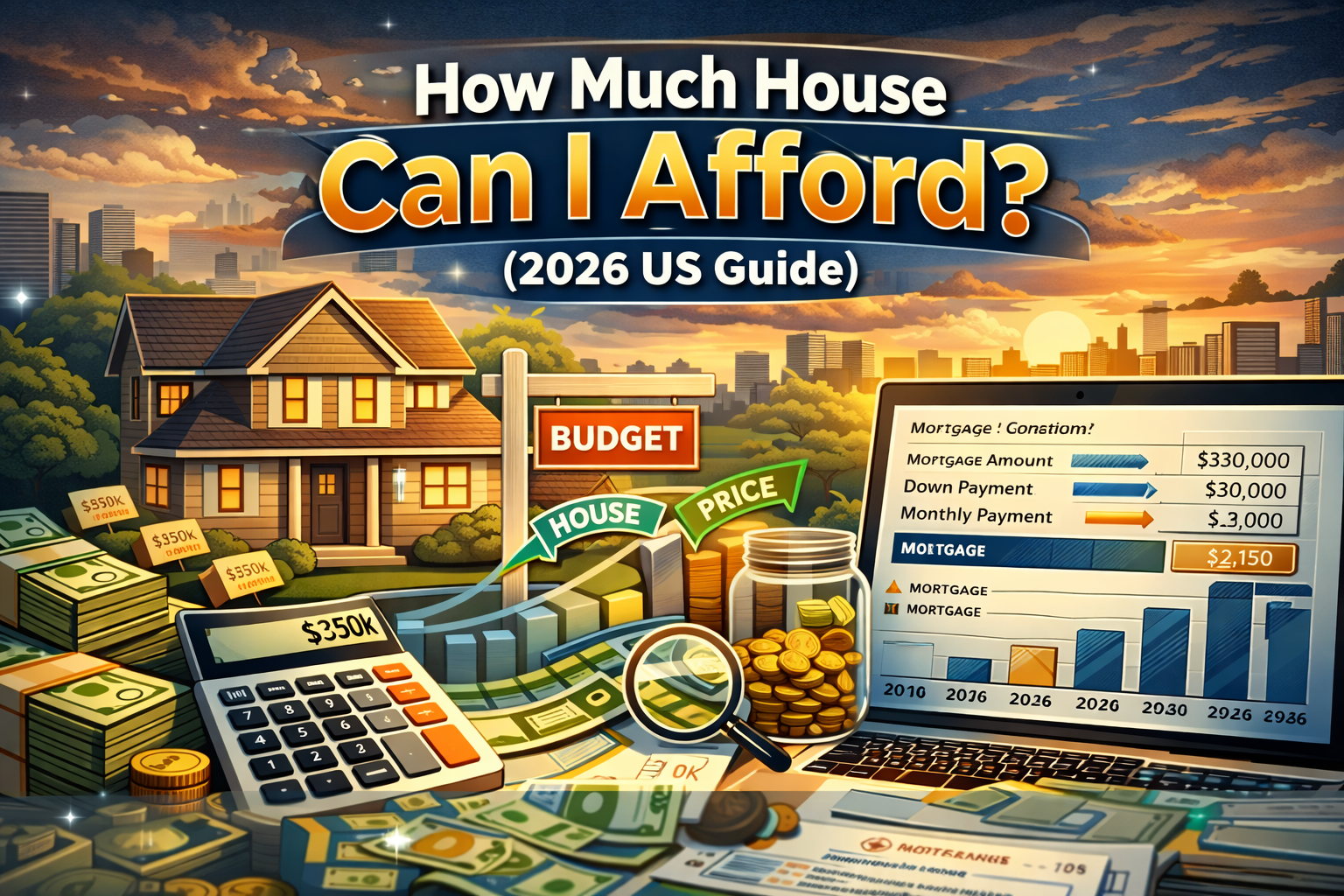
How Much House Can I Afford? (2026 US Guide)
Educational breakdown of home affordability: the 28/36 rule, debt-to-income ratios, current mortgage rates, affordable housing programs, income-based housing for seniors, and how to calculate your real budget before you buy.
How much house can I afford is the most important question to answer before you ever step into an open house or speak to a lender. The number a bank will approve you for and the number you can comfortably afford are often very different figures — and confusing them is one of the most common and costly mistakes first-time homebuyers make.
This guide explains exactly how much house can I afford based on your income, debts, and down payment, covers the key affordability rules, breaks down current mortgage rates, and explains affordable housing options — including income based housing, subsidized housing, housing for seniors based on income, and how to find low income housing with no waiting list.
How Much House Can I Afford? The Short Answer
How much house can I afford depends on four core variables: your gross monthly income, your existing monthly debts, your down payment amount, and the current mortgage interest rate. Most financial planners use the 28/36 rule as the starting benchmark — your monthly housing costs should not exceed 28% of gross income, and your total debt payments should not exceed 36%.
At the current average 30-year mortgage rate of 6.37% (Freddie Mac, April 9, 2026), here is a quick reference for how much house can I afford at common income levels using the 28% rule:
| Annual income | Max monthly payment (28%) | Estimated home price |
|---|---|---|
| $50,000 | ~$1,167 | ~$170,000–$185,000 |
| $70,000 | ~$1,633 | ~$240,000–$290,000 |
| $100,000 | ~$2,333 | ~$360,000–$400,000 |
| $150,000 | ~$3,500 | ~$530,000–$580,000 |
Estimates assume 10% down payment, 6.37% rate, standard property tax and insurance. Your actual number depends on debt, credit score, and location. Use our Mortgage Calculator for a precise figure.
The practical answer to how much house can I afford is not the maximum lender approval — it is the monthly payment that lets you still save for retirement, handle emergencies, and not feel financially stretched every month. Use our Mortgage Calculator to test different price points, down payments, and rates in real time.
The 28/36 Rule: The Standard for How Much House Can I Afford
The most widely used framework for answering how much house can I afford is the 28/36 rule. It works in two layers:
- The 28% front-end ratio: Your total monthly housing costs — mortgage principal and interest, property taxes, homeowners insurance, and HOA fees — should not exceed 28% of your gross monthly income.
- The 36% back-end ratio: Your total monthly debt payments — housing costs plus car loans, student loans, credit card minimums, and all other obligations — should not exceed 36% of your gross monthly income.
Most lenders will actually approve loans with a debt-to-income (DTI) ratio up to 43–50%, but just because a lender will approve you does not mean you should borrow that much. Pushing to a 45% DTI to answer how much house can I afford leaves almost no room for savings, emergencies, or life. The 28/36 rule is the benchmark that keeps your home working for you — not the other way around.
Quick Formula: How Much House Can I Afford in 60 Seconds
Take your annual gross income and multiply by 2.5–3.5 to get a rough home price range. A $80,000 income suggests a comfortable range of $200,000–$280,000. Multiply by 4–5 if you have minimal debt and a large down payment, or stay closer to 2.5× if you carry significant existing debt. Then verify the actual monthly payment using our Mortgage Calculator — because the interest rate dramatically changes the number.
What Determines How Much House Can I Afford?
How much house can I afford is not just about income. Five factors shape the real answer:
1. Your Gross Monthly Income
This is the foundation of every affordability calculation. Lenders use gross income (before taxes), but when you are deciding how much house can I afford for yourself, it is worth also thinking in take-home terms — because your mortgage payment comes from after-tax dollars. Use our Mortgage Calculator alongside your actual net monthly income to see how a payment fits into your real cash flow.
2. Your Existing Debt
Every $500 per month in existing debt payments (car loan, student loan, credit card minimums) reduces your home-buying power by roughly $60,000–$80,000. This is one of the most overlooked factors when people ask how much house can I afford. Paying down high-interest debt before buying can dramatically increase your affordable price range.
3. Your Down Payment
A larger down payment reduces your loan amount, eliminates PMI (private mortgage insurance) at 20%+, and lowers your monthly payment. Going from a 5% to a 20% down payment on a $350,000 home saves roughly $150–$200 per month in PMI alone, plus reduces interest paid over the life of the loan by tens of thousands of dollars.
4. The Mortgage Interest Rate
At the current average 30-year fixed rate of 6.37% (Freddie Mac, April 2026), a $300,000 loan costs approximately $1,875 per month in principal and interest. At a 7% rate, the same loan costs $1,996 — a $121/month difference that compounds to over $43,000 across a 30-year term. When calculating how much house can I afford, the rate matters as much as the price.
5. Property Taxes, Insurance, and HOA Fees
These are the hidden costs that most online calculators underestimate. In high-tax states like New Jersey or Illinois, property taxes alone can add $500–$1,200 per month on a $400,000 home. HOA fees in some communities run $300–$600 per month. Always include the full PITI (principal, interest, taxes, insurance) — and HOA — when calculating how much house can I afford. Our Mortgage Calculator includes fields for all of these.
Affordable Housing: Options When the Market Price Is Out of Reach
If the standard answer to how much house can I afford comes in below the homes available in your target market, there are structured affordable housing programs designed specifically to bridge that gap. Here is a breakdown of the main options.
Subsidized Housing and Public Housing
Subsidized housing is rental housing where the federal, state, or local government pays a portion of the rent on behalf of eligible low-income households. The US Department of Housing and Urban Development (HUD) administers approximately 970,000 public housing units through roughly 3,300 local housing authorities. Income based apartments and public housing units are typically priced at 30% of the tenant’s adjusted gross income — meaning your rent rises and falls with your earnings. This makes them the most accessible form of affordable housing for very low-income households.
Section 8 / Housing Choice Vouchers
The Housing Choice Voucher program — commonly called Section 8 — is the largest federal rental assistance program in the US. It provides vouchers that cover the difference between what a low-income family can afford (30% of income) and the fair market rent for a unit in their area. Unlike fixed public housing, Section 8 allows tenants to rent in the private market, giving them more choice over where they live. The program is income-based — eligibility is generally set at 50% or less of the area median income (AMI).
Low Income Housing Tax Credit (LIHTC) Apartments
The LIHTC program is the largest source of new affordable housing construction in the US. Developers receive federal tax credits in exchange for renting a portion of units to tenants earning 50–60% of area median income at below-market rents. These income based apartments are typically newer and higher-quality than traditional public housing, and many are available in mixed-income communities. To find LIHTC properties in your area, use HUD’s resource locator at hud.gov.
Low Income Housing with No Waiting List
One of the most common frustrations in affordable housing is long waiting lists — some Section 8 waitlists can span years. For those asking about low income housing with no waiting list, the best options are:
- Privately owned LIHTC properties — these set their own leasing timelines and may have immediate availability, especially in areas with new construction.
- USDA Rural Development housing — Section 515 and Section 538 programs fund affordable rental units in rural areas, which often have shorter or no waiting lists compared to urban markets.
- Nonprofit and community land trust housing — local community development organizations sometimes maintain their own affordable unit lists with shorter wait times than government programs.
- State emergency housing programs — many states maintain rapid-rehousing programs with expedited placement for qualifying households.
Housing for Seniors Based on Income: Affordable Senior Housing Options
For older Americans asking how much house can I afford on a fixed retirement income, the answer often involves purpose-built housing for seniors based on income rather than traditional homeownership. Affordable senior housing programs are specifically designed for adults aged 55 or 62 and older with limited income, and they offer some of the most accessible and stable housing options available.
Section 202 Supportive Housing for the Elderly
HUD’s Section 202 program funds the development and operation of senior living apartments based on income for very low-income seniors (aged 62+) earning 50% or less of area median income. Residents pay 30% of their adjusted income toward rent, with the federal government subsidising the remainder. These communities typically include supportive services such as transportation, housekeeping assistance, and health support — making them among the most comprehensive affordable senior housing options in the US.
Low-Income Housing Tax Credit (LIHTC) Senior Communities
Many LIHTC developments are designated as 55+ or 62+ senior communities with income-restricted rents. These senior living apartments based on income offer below-market rents in dedicated senior buildings, often with amenities, communal spaces, and optional services. Income limits typically range from 30–60% of area median income depending on the specific development.
Public Housing for Seniors
Many local housing authorities operate dedicated senior public housing buildings that offer income based housing for elderly residents at 30% of adjusted income. These are distinct from general public housing and are often better maintained and more stable communities. Contact your local housing authority directly to inquire about affordable senior housing availability in your area.
How to Find Affordable Senior Housing
The most reliable way to find housing for seniors based on income in your area is to:
- Search HUD’s Affordable Apartment Search tool at hud.gov
- Contact your local Area Agency on Aging (AAA) — they maintain local inventories of affordable senior housing
- Search the National Council on Aging’s BenefitsCheckUp database for senior-specific housing assistance
- Contact your state housing finance agency, which typically administers state-funded senior housing programs in addition to federal ones
How Much House Can I Afford — or Should I Rent Instead?
Before deciding how much house can I afford to buy, it is worth asking whether buying actually makes financial sense for your situation. In many high-cost markets, renting remains the smarter financial decision — especially if you plan to move within 5 years or cannot put down 20%.
The key variables in the rent vs buy decision are: the price-to-rent ratio in your market, how long you plan to stay, how much you have for a down payment, and how alternative use of that down payment capital (invested in the market) would perform over the same period. Use our Rent vs Buy Calculator to run your specific numbers and find your break-even point — the exact year at which buying becomes cheaper than renting in your scenario.
💡 Rule of thumb: If the price-to-rent ratio in your area is above 20 (meaning home prices are more than 20× annual rent), buying is typically less advantageous than renting unless you plan to stay for 7+ years. Use our Rent vs Buy Calculator to find your personal break-even year.
How Much House Can I Afford at My Salary?
Here is a practical salary-by-salary breakdown of how much house can I afford using the 28% rule, current 6.37% 30-year rate, 10% down payment, and standard property tax/insurance estimates:
How Much House Can I Afford on a $50,000 Salary?
On a $50,000 annual salary ($4,167/month gross), the 28% rule gives a maximum housing payment of approximately $1,167/month. At current rates with a 10% down payment, this translates to a home price of roughly $170,000–$185,000. In most major US cities this is challenging, but achievable in the Midwest and South.
How Much House Can I Afford on a $70,000 Salary?
On $70,000 per year ($5,833/month gross), your maximum monthly housing payment is approximately $1,633. This supports a home price of roughly $240,000–$290,000 depending on debt load, down payment, and location. This is close to the US national median home price range in many mid-tier markets.
How Much House Can I Afford on a $100,000 Salary?
At $100,000 per year ($8,333/month gross), the 28% rule supports a monthly payment of approximately $2,333, translating to a home price of roughly $360,000–$425,000 with minimal other debt. At the 36% back-end limit with $500 in monthly existing debt, buying power reduces to approximately $310,000–$360,000.
How Much House Can I Afford on a $150,000 Salary?
On $150,000 per year ($12,500/month gross), the 28% rule supports a monthly payment of approximately $3,500, supporting a home price range of roughly $530,000–$600,000 with good credit and a 20% down payment. In high-cost markets like California or New York, this still lands in the entry-level range.
How to Increase How Much House You Can Afford
If the answer to how much house can I afford is lower than you need for your target market, here are the most effective levers to improve your position:
- Pay down existing debt first. Reducing your monthly debt obligations by $300–$500 can increase your home-buying power by $50,000–$80,000 under the 36% DTI rule.
- Improve your credit score. Moving from a 680 to a 740+ credit score can lower your mortgage rate by 0.5–1.0%, significantly increasing how much house can I afford for the same monthly payment.
- Save a larger down payment. A 20% down payment eliminates PMI, reduces your loan amount, and typically secures better rates — all of which increase your effective affordability.
- Consider FHA loans. FHA loans allow down payments as low as 3.5% and are more accessible for borrowers with lower credit scores, though they carry mandatory mortgage insurance premiums.
- Explore down payment assistance programs. Many states and local governments offer grants or zero-interest second loans to first-time homebuyers — sometimes covering the full down payment. Check your state’s housing finance agency website for current programs.
- Buy in a more affordable market. Location is often the most powerful variable in how much house can I afford. The same $250,000 budget buys dramatically different homes in Ohio versus California.
Sources & Reference Links
Mortgage rate data cited in this article comes from Freddie Mac’s Primary Mortgage Market Survey (PMMS), released April 9, 2026, which reported the 30-year fixed rate at 6.37%.
Affordable housing program information references official guidance from the US Department of Housing and Urban Development (HUD), including the Section 202, Section 8 Housing Choice Voucher, and Low-Income Housing Tax Credit programs.
The 28/36 affordability rule and income-based home price estimates reference widely cited guidelines from the Consumer Financial Protection Bureau (CFPB).
These external links are provided for general reference. InvestingLab.com is not affiliated with these organisations.
FAQ
Common questions about how much house can I afford, affordable housing, and income based housing options.
How much house can I afford on my salary?
What is the 28/36 rule for home affordability?
What is affordable housing and how do I qualify?
What is income based housing and how does it work?
What is housing for seniors based on income?
Is there low income housing with no waiting list?
Should I buy a house or rent — and how does it affect how much house I can afford?
Try the Mortgage Calculator
The most precise way to answer how much house can I afford is to run your actual numbers — income, down payment, existing debts, location, and current rate — through a real mortgage calculator. Our free tool does exactly that.
- Estimate monthly payments at any price point and down payment
- See the full PITI breakdown — principal, interest, taxes, and insurance
- Compare 15-year vs 30-year scenarios side by side
- No sign-up required — runs entirely in your browser
👉 Try the Mortgage Calculator →
Also compare whether buying or renting makes more sense for your situation using our Rent vs Buy Calculator — it models your break-even year and total cost comparison across both scenarios.
By subscribing, you agree to receive email updates. Unsubscribe anytime. See our Privacy Policy.
Disclaimer
This article is for general educational and informational purposes only. It does not provide financial, tax, legal, or mortgage advice. Home affordability estimates are illustrative and based on simplified assumptions — actual figures depend on your specific income, debts, credit score, location, and lender. Mortgage rate data reflects published averages as of April 2026 and may change. Always verify with a licensed mortgage professional before making any homebuying decision. For assumptions and limitations, see How Calculators Work and Disclaimer.