
Debt vs Invest Calculator for US Market
Should extra money go toward paying off debt sooner, or investing for potential growth? Compare both paths with transparent assumptions — no sign-up required.
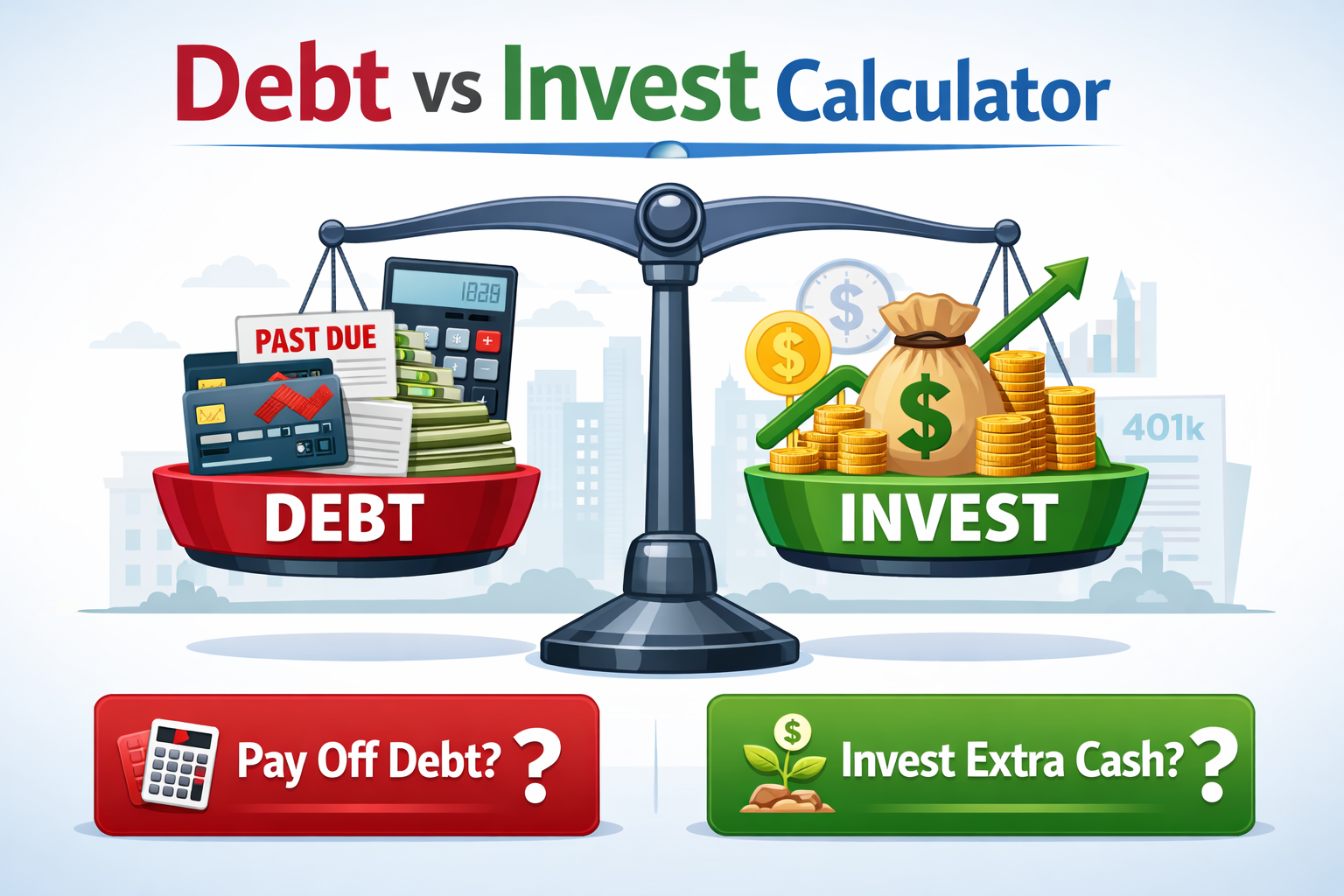
- Scenario A: Pay minimum + extra to eliminate debt sooner.
- Scenario B: Pay minimum only and invest the extra each month.
| Debt type | Typical APR |
|---|---|
| Credit cards | 18–29% |
| Personal loans | 8–20% |
| Auto loans | 5–10% |
| Student loans (federal) | 5–8% |
| Mortgage (30-yr fixed) | 6–7% |
| HELOC | 7–10% |
Free Debt vs Invest Calculator (US) – Pay Off Debt or Invest Extra Money?
Use this Debt vs Invest Calculator to test a common question: should extra money go toward paying off debt sooner, or investing for potential growth? This tool compares two simplified paths: (A) pay minimum + extra toward debt, versus (B) pay minimum only and invest the extra.
- See months-to-payoff and interest paid under each scenario
- Estimate investment growth over a selected time horizon
- Compare net worth outcomes and an estimated breakeven return
Best practice: run 3–5 scenarios (lower return, higher return, different APR) to see how sensitive the outcome is to your assumptions.
Should I Pay Off Debt or Invest?
The debt vs invest question is one of the most common in personal finance. The answer depends on three key variables: your debt’s APR, your expected investment return, and your time horizon. This debt vs invest calculator lets you test your exact numbers rather than relying on general rules.
The mathematical answer is straightforward: if your debt APR exceeds your expected after-tax investment return, paying off debt is equivalent to earning a guaranteed, risk-free return equal to your APR. For high-interest credit card debt at 20%+, almost no investment reliably beats that threshold over short periods.
When Paying Off Debt Wins
Scenario A typically wins when your debt APR is high (credit cards, personal loans), your investment return expectation is conservative (3–5%), or your time horizon is short. Eliminating debt also improves cash flow and reduces financial stress — benefits not captured in the numbers alone.
When Investing Wins
Scenario B can produce a higher net worth when your debt APR is relatively low (mortgage, subsidized student loans), you have a long time horizon, and you expect above-average investment returns. The key risk: investment returns are not guaranteed.
Methodology & Data Sources
Debt vs Invest calculator is an educational simulation using simplified assumptions: fixed interest rates, steady investment returns, and monthly compounding. Concepts related to consumer debt are informed by guidance from the Consumer Financial Protection Bureau (CFPB). Investment return assumptions align with educational resources from the SEC. Interest rate data is consistent with Federal Reserve publications.
These sources are for general educational reference only. InvestingLab.com is not affiliated with any government agency. See How Calculators Work and Disclaimer.
Frequently Asked Questions
Is this Debt vs Invest calculator financial advice?
Why does high-interest debt often “win”?
Why doesn’t this include market crashes or volatility?
What exactly is this calculator comparing?
Is paying debt the same as a “guaranteed return”?
Why can the “winner” change when I adjust assumptions?
Does this include employer 401(k) match or taxes?
Why is there a breakeven return shown?
Related Tools
Use these tools alongside the Debt vs Invest Calculator to build a complete financial picture: